


This page last modified 2018 November 02
A PDF version of this page can be downloaded here.
Choosing a First Astronomical Telescope
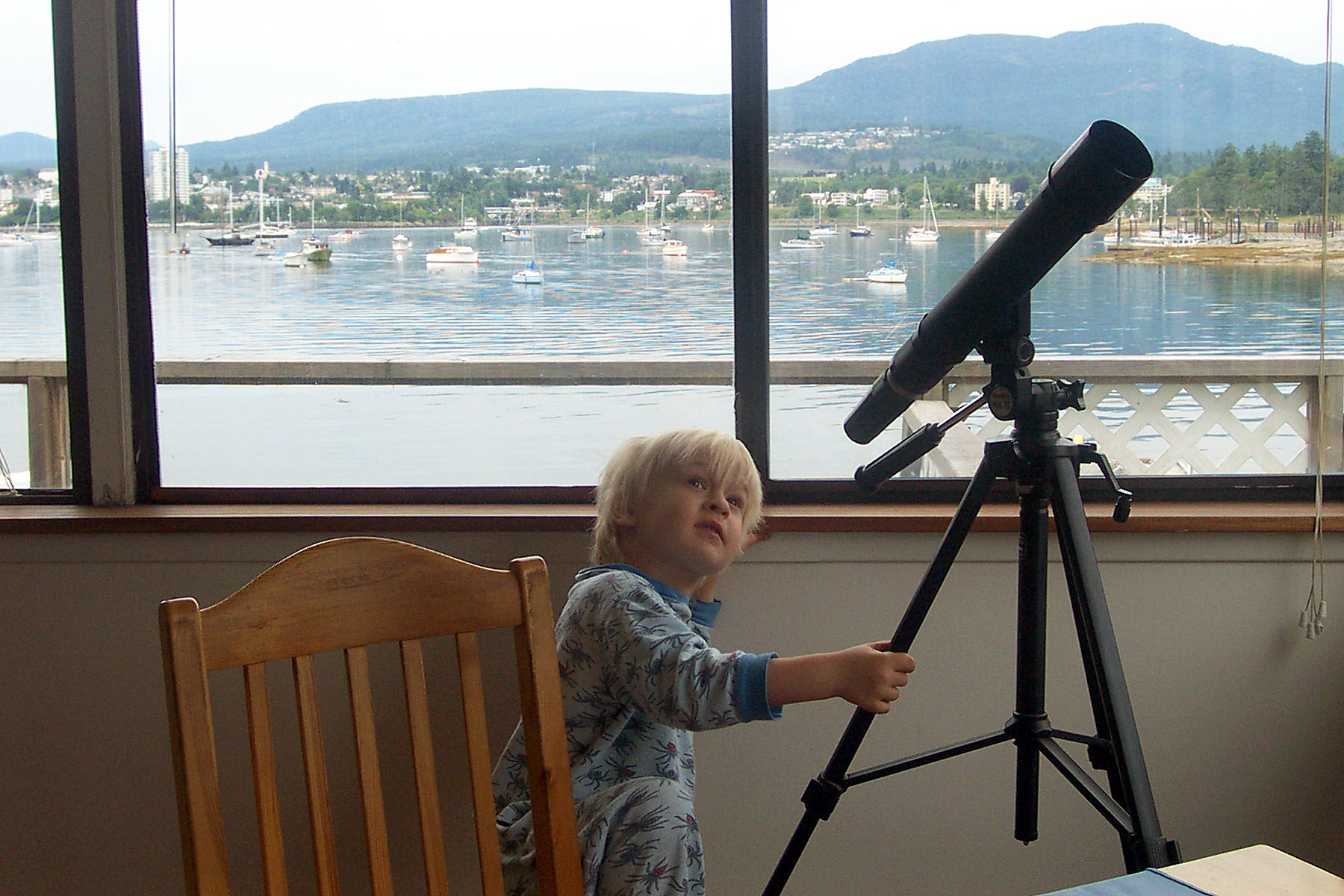
Image: Kid and Telescope by Gerry Thomasen (CC BY 2.0)
Reader comments from 2017:
"A no-nonsense article"
"Excellent stuff! Some damned good advice here!"
For choosing a basic set of eyepieces, click here (opens in a new tab).
For choosing binoculars for astronomy, click here (opens in a new tab).
Contents
1. Introduction
2. Factors to Consider
3. Who Makes Them?
4. Telescope and Mount Types
5. Which Telescope (Best Buys)
6. Sources of Further Information
Affiliation Disclosure
1. Introduction
The recent revival of interest in amateur astronomy has led to a bewildering
variety of telescopes on the market, and an increasing number of retailers, some
of which are primarily interested in taking your money. It is easy for a newcomer
to be bamboozled by the advertising hype and to spend money upon something that
begs to be replaced after a very short time. It is best to purchase from a
knowledgeable and reputable retailer. If a retailer seems to be offering goods very much cheaper than others, check that these are not "grey" imports. If they are, they are unlikely to have a UK warranty. Grey importers also take business away from reputable retailers; you may wish to consider whether this is something you want to support.
There is
no such thing as a "perfect starter scope". The one that is right for
you depends upon a number of considerations. For this reason, it would be a good
idea to try things out before you buy. Many
Astronomical
Societies hold field meetings (aka observing evenings) where newcomers can
try out different kit and get advice from experienced astronomers. At the very
least, you should see if you can find a review of your
intended purchase.
Caveat. What
follows, especially the BEST BUY,
recommendations, represents my opinions, which are formed by my own prejudices.
Briefly, these are that decent optics and accessories on a sturdy mount are
worth a great deal more than attractive computerised kit that is under-mounted
and comes with bottom-of-the-range accessories. Other people have different
opinions. Solicit them, either passively from reviews, or actively from
experienced amateur astronomers, either in person or on internet
forums and mailing lists The prices (and therefore relative prices of
various options) are those in the UK .
2. Factors to Consider
- Budget. This will possibly be the most important constraint for a beginner. At, say, £200 you are much more limited for choice for a good scope than at, say, £1500.
- Portability. If you've got to lug it down 3 flights of stairs in order to observe, this is going to be a very important factor! If you will need to transport the telescope to a dark site, make sure that you can easily get it in and out of the vehicle. Tight fits are no fun in the dark.
- Ease of set-up. By definition, a telescope that is not used is useless. If your telescope is difficult to set up (often in the dark), it will get less use than one that is easy to set up.
- Upgradeability. Do you want a telescope that is upgradeable when you become more experienced and/or have more funds available?
- Astro targets of interest. The requirements for observing detail on the Moon and bright planets are different to those for detecting faint deep sky objects.
- Astrophotography. If you want to attempt anything other than very short exposures, you will need a good motorised equatorial mount at the very least.
I give more detailed advice on this in my book AstroFAQs
3. Who Makes Them?
A frequent question is "What is a good brand name?" Frequently a telescope from a manufacturer is branded by different companies, but is essentially the same telescope in different "livery"; in such circumstances, one cannot recommend one brand over another. For example, the Orion Short Tube 80 is the same telescope, manufactured by the Chinese company Synta, as the Celestron Firstscope 80 EQ WA, the Helios StarTravel 80 and the Skywatcher StarTravel 80. Nowadays, almost all of the telescopes that are intended beginners are of Far Eastern — usually Chinese or Taiwanese — manufacture, including those from the US "big three" (Celestron, Meade and Orion) and those (e.g. Tasco, Bushnell) that are usually distributed through non-specialist retailers like department stores and camera shops. The quality of these telescopes is variable; within the same model there is often a range of quality, hence it is impossible to categorise such telescopes as "good" or "bad". However, in the last few years improvements in the manufacturing processes have resulted in a general increase in quality and consistency and these instruments can offer excellent value for money.
4. Telescope and Mount Types
Refractors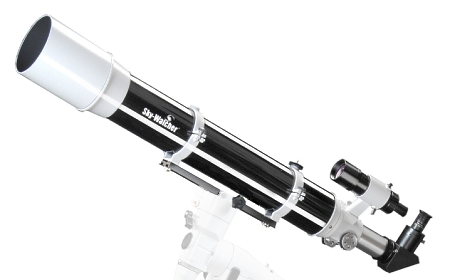 |
These are what most people immediately call to mind when they hear the word "telescope"; they have lenses at the front. Good refractors give superb images, but they are expensive to make, especially in large sizes, because they use exotic glass. They need very little maintenance. They are usually preferred for observing the planets and Moon. |
Reflectors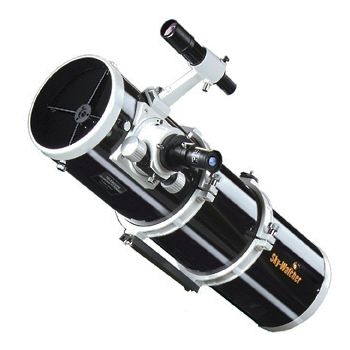 |
Newtonians can be made inexpensively because they have only two optical surfaces and do not need special glass. They give you the most aperture for your expenditure, and so are preferred for visual observation of the deep sky. However, they have a tendency to go out of alignment (lose collimation), so you will need to learn how to collimate them. |
Catadioptrics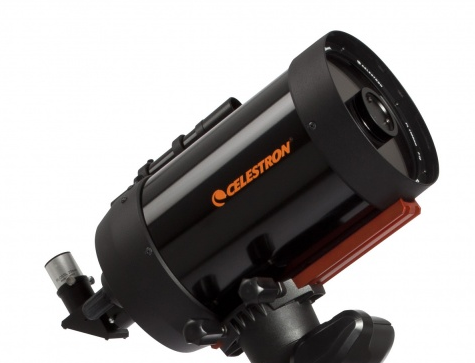 |
"Cats" are good multi-purpose instruments. The folded light-path makes them more compact than Newtonians or refractors. They are more expensive than equivalent-sized Newtonian, but less expensive than the equivalent-sized refractor. Like refractors, they need little maintenance. |
Altazimuth (AZ) Mounts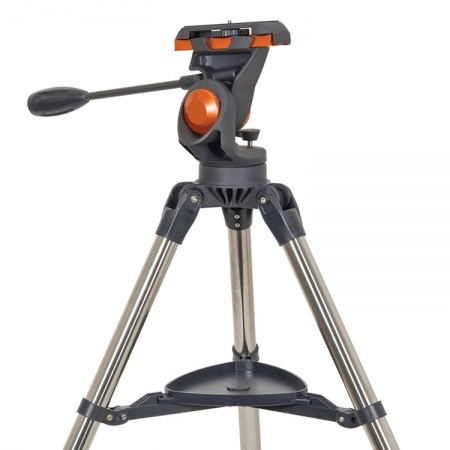 |
"Altaz" mounts are the simplest mounts; they are therefore the least expensive. They move up and down (altitude), and side-to side (azimuth). To track an object, both motions must be used. They suffer from image rotation, so they are difficult to use for long-exposure astro-imaging. |
Dobsonian Mounts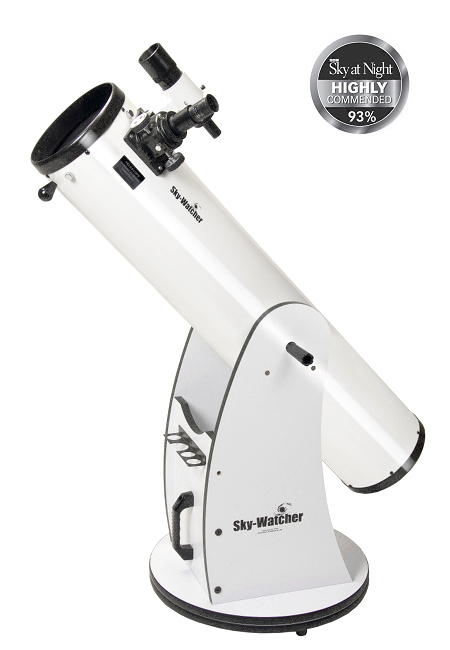 |
"Dobs" are simple altazimuth mounts that are held together by gravity. They are usually used to mount Newtonian reflectors. "Dobs" make excellent first telescopes, owing to their simplicity and the fact that they give you the most aperture for your expenditure. |
Equatorial Mounts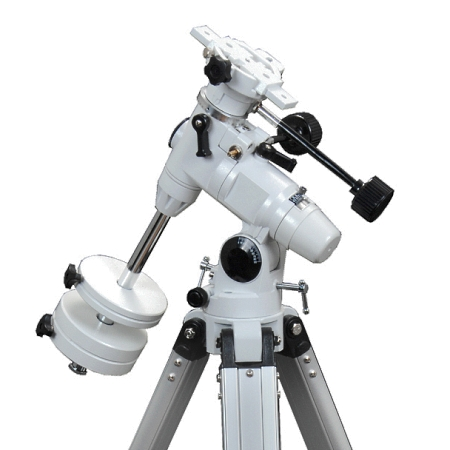 |
Equatorial mounts can track an object using only one motion and so are the preferred option for lunar and planetary observations, where high magnifications are typical. They need to be accurately aligned to do this; this takes time unless it is permanently installed in an observatory. They do not suffer from image rotation, so are the simplest mount for long-exposure astro-imaging. |
5. Which Telescope?
This makes no pretence to be a definitive list of good telescopes, but all equipment on it is stuff that I have used and, in some cases, still own. It
represents my opinion of good value-for-money telescopes in each price range.
There are almost certainly good buys that I have omitted owing to my ignorance
of them. With new models being introduced all the time and with prices
fluctuating, it is inevitable that this list will become out of date in some
respects — so check the date at the top of the page.
First,
there are some general "rules":
- Astronomers use telescopes primarily to gather more light. This requires aperture, not magnification. Always be suspicious if a vendor emphasises the magnification. Exercise extreme caution if the vendor advertises magnification that exceeds x50 per inch of aperture.
- Consider a binocular. Yes, I know you want a telescope, but a binocular is merely two telescopes mounted in tandem. There are some very good binoculars available in in each of the price ranges below. These give you more pleasure and less frustration than you will get from a bad telescope. Most serious amateur astronomers frequently use a binocular as well as a telescope. For the last decade or so, I have been using 100mm binoculars in preference to telescopes.
- The combination of good optics and a poor mount will perform poorly. A shaky mount with motion that is not silky-smooth will soon become infuriating. The not-very-old adage was that the mount should cost at least as much as the telescope; the older one was that it should cost twice as much!
- Don't skimp on eyepieces. Many telescopes are sold without them, so you should allow for them in your budget. They are part of the optical system and need to be of quality that is at least as good as the rest of it.
- Consider buying second-hand — you can get good second-hand kit at extremely good prices. See the adverts in UK-Astronomy Buy-Sell, or the classified ads in Stargazers Lounge.
- Lastly, and possibly most importantly, an astronomical telescope should be a precision scientific instrument and not a toy, an ornament, or a fashion accessory. Choose your telescope, and your supplier, with this in mind.
Under £100
Skywatcher Heritage 100P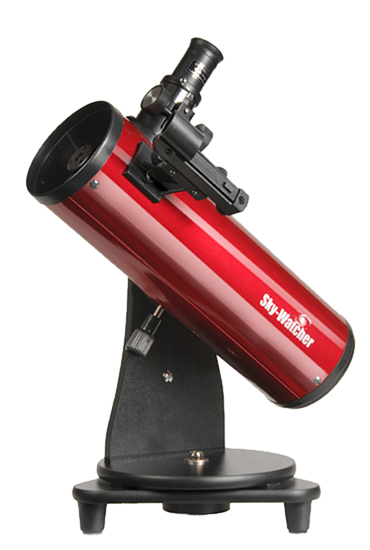 |
This is a table-top mounted Dobsonian. It is very portable and easy to set up. However, it does suffer from an awkward finder position unless you are very short (which makes it more suitable for children) and, of course, requires a sturdy table. BEST BUY for a child's first telescope under £100. |
Skywatcher StarTravel-80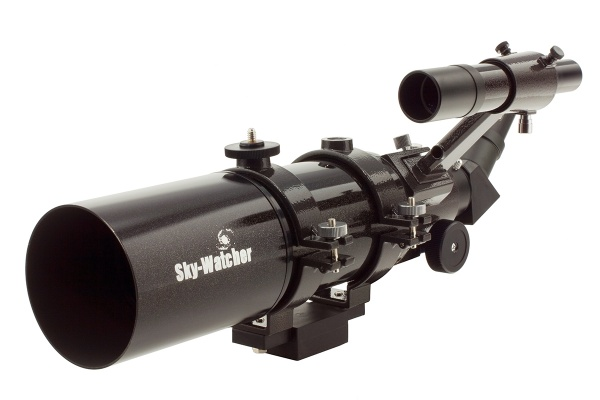 |
An extremely portable scope that is excellent value for money. It excels at observation of open clusters and is acceptably good for the Moon and bright planets. If you have a decent photographic tripod, it is worth getting this telescope as the OTA (optical tube assembly) only option. If you upgrade later, it still makes a useful travel scope or guidescope for astrophotography. In this guise, it is the BEST BUY for under £100. |
| Second hand. (see above) | |
| Binoculars are often a better bet in this price range. My guide to choosing a first binocular for astronomy is here. | |
| There is a lot of rubbish in this price range. Most of it is on insubstantial mounts and comes with atrocious accessories. If this is your budget and you are tempted by something else, check out the tutorial on evaluating telescopes before you buy. If you already have one, check out my tutorial on upgrading them. | |
£100 - £200
Skywatcher SkyMax 90, unmounted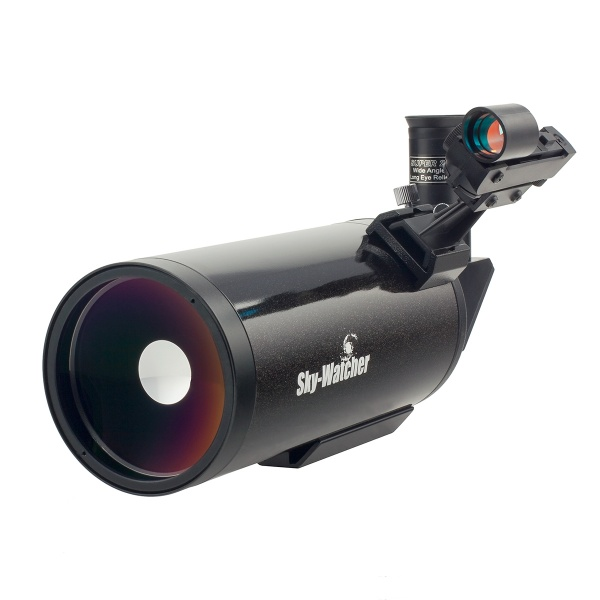 |
Extremely good for the Moon, planets and double stars. Worth considering only if you already have a sturdy photographic tripod or other suitable mount to put it on. |
Skywatcher Heritage-130p Flextube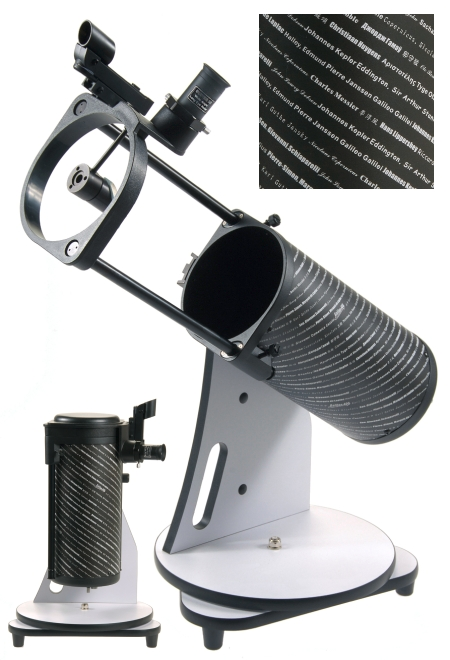 |
Possibly the nearest thing to an ideal beginner telescope. It has a decent light grasp, and a clever design that makes it very compact and, therefore, portable. It is quick and easy to set up, but requires a sturdy table or similar support. It has a standard Vixen/Skywatcher-type dovetail bar, so you can upgrade it with any mount that has the Vixen/Skywatcher saddle (e.g. AZ4, AZ5, or Star Discovery GOTO). (Don’t be tempted to put it on an equatorial mount unless you are in training as a contortionist; the eyepiece can end up in remarkably awkward positions!) BEST BUY for under £150. |
£200 - £300
Skywatcher Evostar 90 (EQ3-2)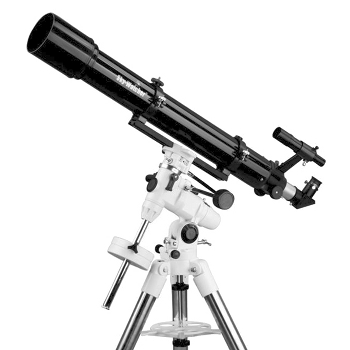 |
Good optics on a mount that is suitable for the telescope. This is possibly the best beginner option for a lunar and planetary telescope. The mount can be upgraded with motors and computerised GOTO. BEST BUY at under £250 |
|
Skywatcher Skyliner 200P Dobsonian |
Basic but good; has the greatest aperture in this price range. If you're sure this hobby is for you, this may be the best option for a basic all-round scope that will meet your needs for several years, especially if your interest is the Deep Sky. You should probably handle one before buying: they are bulky and quite heavy. BEST BUY at under £300 |
£300 - £450
Skywatcher Explorer 130P SynScan AZ GOTO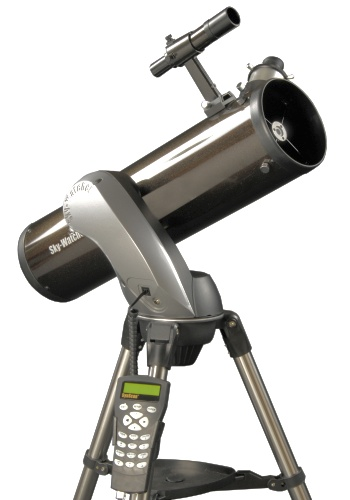 |
Probably the cheapest computerised telescope worth getting. Reasonably good mount, and a decent aperture to get you started. |
Skywatcher Skymax 127 EQ3-2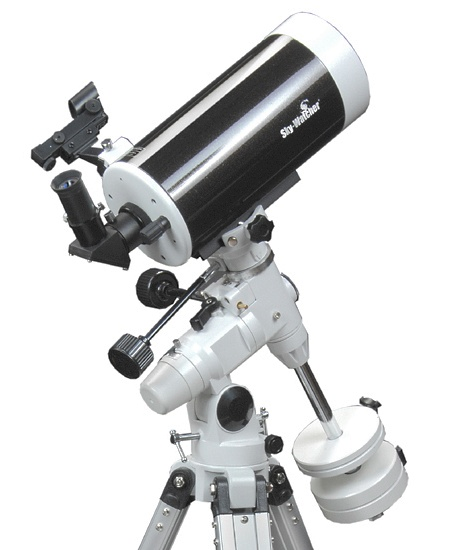 |
This is a very nice telescope and the mount is good for visual observation. The mount can be upgraded with motors and computerised GOTO. BEST BUY at under £450 |
Over £450
| Possibly not a wise amount to spend on a "starter" telescope unless you have tried it out and are convinced that you want it. At this price, it is often best to choose the telescope, the mount, the eyepieces and the other accessories separately, in order to meet your specific requirements. If this is your situation, you probably don’t need this guide anyway! | |
6. Sources and Further Information
Telescope Retailers
The following are retailers of "starter scopes" from whom I have purchased astronomical equipment within the last few years, and from whom I would do so again, i.e. those whom I can recommend from my recent personal experience. The absence of a retailer from this list does not imply that it is not reputable; the absence may be due to my not having purchased anything from that retailer.
Reviews
There are reviews of telescopes and other astro kit at:
Internet Forums and Mailing Lists
The following are useful sources of information on intended purchases.
Remember to get more than one opinion — there is a lot of information and
opinion on the internet, and some of it is rubbish! However, an advantage of
Usenet newsgroups and Internet mailing lists is that there is an element of
peer-review in that fallacious statements and unsupportable opinions will be
challenged — for this reason it is advisable to verify the information you
receive in any private replies that people send you.
- Internet Forums: The largest of these in the UK is Stargazer's Lounge. It has Beginners and Equipment sections where you may solicit a variety of opinions.
- Mailing Lists: There are many at Yahoogroups,
some general, such as the [telescopes] list, some slightly more focused, such as
the [sct-user] list, and some concentrating on a particular telescope, such as
the [80f5] list. To subscribe to a Yahoogroups mailing list, either do it on
the web site or send a blank email (without the square brackets), from the
address where you want the list mail to be sent, to[groupname]-subscribe@yahoogroups.com.
Subscribe to [telescopes]
Subscribe to [sct-user]
Subscribe to [80f5]
Subscribe to [telescopesuk] - You could also consult the
Telescope Buyers
FAQ; it's very US-oriented, but still useful.
Affiliation
Stephen Tonkin is an affiliate of First Light Optics which provides a means for sites to earn commission by advertising and linking to firstlightoptics.com.
I recognise that, when something is being sold on commission, the buyer is justified in being wary of the seller's descriptions. However, I have, over many years, developed a reputation of which I am very jealous. I will not, therefore, compromise my integrity and risk damaging my reputation by knowingly describing something inaccurately.
For this reason, most of what I recommend on this page is something that I have used; in a few cases it may have been used by somebody whose opinions I trust. Some of this is equipment I last used several years ago, before I considered developing this guide. It is also possible that what I am suggesting may be based on a superseded model, so my opinion may be out of date.
I am pleased to have become an affiliate of First Light Optics (FLO) (which is at least as jealous of its reputation as I am of mine), and which will back up any sales with its peerless after-sales service.
In the two decades since I started The Astronomical Unit, several retailers have approached me about advertising their wares on my site; I have always declined because of the risk of being perceived to be "in a retailer's pocket". However, I am satisfied that this arrangement does not carry that risk: FLO has not merely agreed, but has actively encouraged me to publish a negative review if that is my opinion (simply put, false-positive reviews lead to a lot of equipment returns, which is expensive for retailers).
